

The first shift of a turnaround says a great deal about the months that came before it. Crews arrive, permits are issued and supervisors start handing out work. Some jobs start cleanly and run to plan. Others stop within the first hour, because the gasket kit is still in the storeroom, the scaffold has not been built, an isolation point on the drawing does not match the plant, or a contractor crew is waiting on a permit nobody raised.
None of those jobs was unplanned. Each had a work order, an estimate and a slot in the schedule. What they were missing was readiness, and inside a fixed window the gap between a planned job and a ready one is paid for in hours that cannot be recovered.
Planned and ready are not the same status
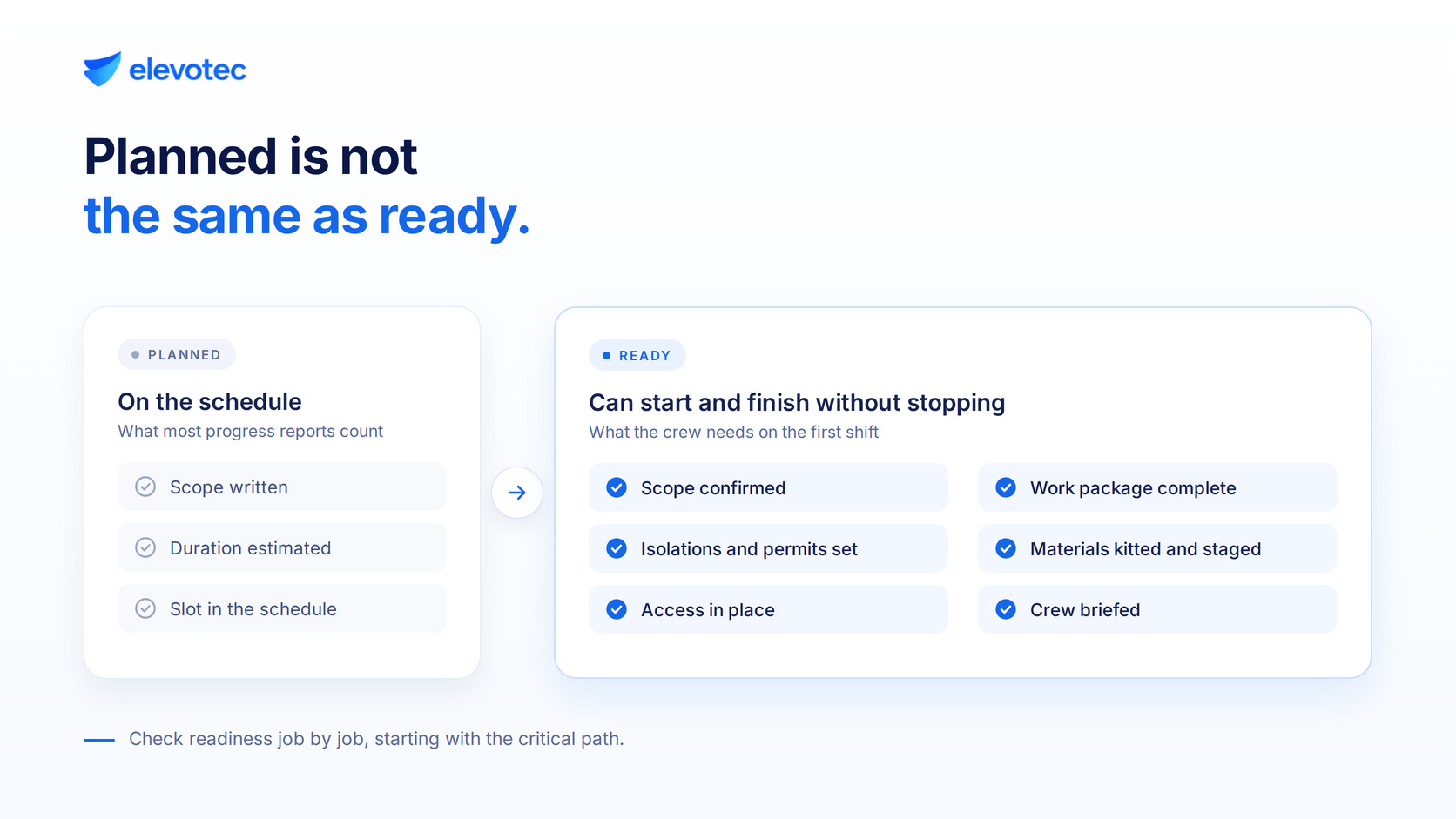
Most turnaround plans track planning progress, meaning how many work orders have been created, estimated and scheduled. That work is necessary, and it is also the easier half. A planned job has a scope, a duration and a place in the sequence. A ready job has everything it needs to start and finish without stopping: a confirmed scope, a complete work package, defined isolations and permits, materials kitted against the job, access in place, and a crew that knows what it is walking into.
The gap between the two is where turnaround time tends to go. A job that is planned but not ready never fails on paper. It fails at the asset, on the day, when the people who could have closed the gap weeks earlier are busy with something else.
Turnaround readiness has to be judged job by job
Turnaround progress is usually reported in totals, such as the share of work orders planned, the share of materials received or the share of contractors mobilized. Totals are useful in the steering meeting, and they hide the jobs that matter most. A high share of materials received says nothing about whether the parts for the exchanger rebuild on the critical path are among them.
Readiness works better as a test applied to each job, weighted by where the job sits in the schedule and what a delayed start would cost. A routine valve change that is not ready can usually wait for a quieter hour. A critical-path job that is not ready on day one can push the whole window. The teams that run controlled turnarounds tend to know, weeks out, exactly which critical jobs are not ready yet and why.
A work package should work for someone who has never seen the asset
Turnarounds bring in people who do not know the plant, including contractor crews, specialist vendors and technicians from other sites. They can only work from what they are given. A package that makes sense to the planner who wrote it, because the planner already knows the equipment, can leave a visiting crew guessing about the isolation sequence, the special tools or what was found the last time the unit was opened.
A useful test is whether a competent crew that has never seen the asset could complete the job from the package and the permit alone. That means steps written for this job rather than copied from a generic template, isolation points that match the plant as it stands today, drawings and photographs attached to the work order, the findings from the last opening, and the hold points where inspection or engineering has to sign off. Every question a crew has to ask on the day is time the window was never built to absorb.
Materials are ready when they are kitted, not when they are received
Materials are where readiness most often breaks down, because the status that gets reported is rarely the status that matters. A purchase order does not make a part available, and neither does a receipt in the storeroom. For a turnaround job, the part is ready when it has been checked against the job’s parts list, kitted with the gaskets, fasteners and consumables that go with it, labelled to the work order and staged where the crew will look for it.
Long-lead items need their own attention. They are best tracked against the date the job needs them rather than the date the supplier promised, so a slipping delivery shows up as a risk to a specific job while there is still time to plan around it. The same discipline applies in reverse once the window closes. Unused material returned against the right records keeps the next turnaround from inheriting a storeroom nobody fully trusts.
Late scope needs the same test
Every turnaround attracts late additions. Some are genuine, such as a finding from a recent inspection or a failure in the last weeks of operation. Others are requests that simply missed the scope deadline. The risk is that late work enters the schedule as planned without ever passing the readiness test that earlier work had to pass.
A simple rule helps. Work added after the scope freeze goes through the same readiness checks as everything else, with a named owner and an agreed answer for what happens if it is not ready in time. It can be prepared as contingency work for a known gap in the schedule, or it can move to the next opportunity. What it should not do is reach the first shift as a work order with a title and nothing behind it.
What the system can show, and what it cannot
Readiness is hard to manage in spreadsheets, because it changes daily and depends on information held by different teams. Octave Attune EAM brings it together on the work order itself, with the job plan, the parts list and the status of each item, the safety and permit requirements, the labour assignment and the attached documents in one place. With the turnaround work grouped together, planners and supervisors can review readiness job by job, focus on the critical path and see what is still missing while there is time to act.
The system cannot decide that a job is ready. That judgment belongs to the planners and supervisors who know the work, and the strongest turnaround teams give it real weight, including the authority to hold a job that is not ready rather than start it and stop it. What the system can do is make the gaps visible early, to the people who can close them.
The first shift is a readiness review either way
Every turnaround runs a readiness review, whether anyone schedules one or not. If it has not happened beforehand, it happens on the first shift, at the asset, when a crew finds out whether everything they need is there. The organizations that run controlled turnarounds hold that review weeks earlier, job by job, while the gaps can still be closed from a desk rather than discovered on a scaffold.
At Elevotec, we work with maintenance and operations teams on how turnaround work is planned, packaged and tracked in Octave Attune EAM, so that readiness is something the team can see rather than assume. If a turnaround is on your calendar for the year ahead, the way readiness is tracked today is a good place to start that conversation.