
Preventive maintenance (PM) compliance is one of the clearest measures maintenance leaders have, and one of the most often over-read. A low rate points to a real problem and deserves the attention it gets. A strong rate confirms that scheduled work is being completed and that planned activity is under reasonable control. It says nothing about whether each task still belongs in the schedule, or whether its interval still fits the asset.
That gap matters most in mature operations. A site can run its PM program with real discipline and still live with repeat failures on production-critical assets and inspections that rarely find anything. Completing the schedule shows execution, and whether the schedule is right is a separate question.
PM programs accumulate operating history
Very few established plants built their current PM program from a blank sheet, and most programs grew in layers. Some tasks came from the equipment manufacturer and others were added at commissioning or during a system implementation. Experienced technicians added checks after failures they had lived through, and more PMs followed breakdowns, audits, safety concerns and quality issues. Most of those additions made sense at the time.
Removals are far rarer, for understandable reasons. Taking out an inspection that has been done monthly for years means someone has to argue it is no longer needed and then own that call if something fails. Against that risk, the annual cost of carrying on looks small, so PM libraries keep growing.
After enough years, the schedule is part current strategy and part institutional history. Equipment that now runs around the clock may still be maintained at a frequency set when it ran a single shift, and the library is rarely challenged often enough to catch that kind of drift.
Completion does not establish effectiveness
Take a monthly inspection on a production-critical gearbox. The technician attends on schedule, follows the procedure, records the readings and closes the work order correctly, which is exactly what the compliance measure is looking for.
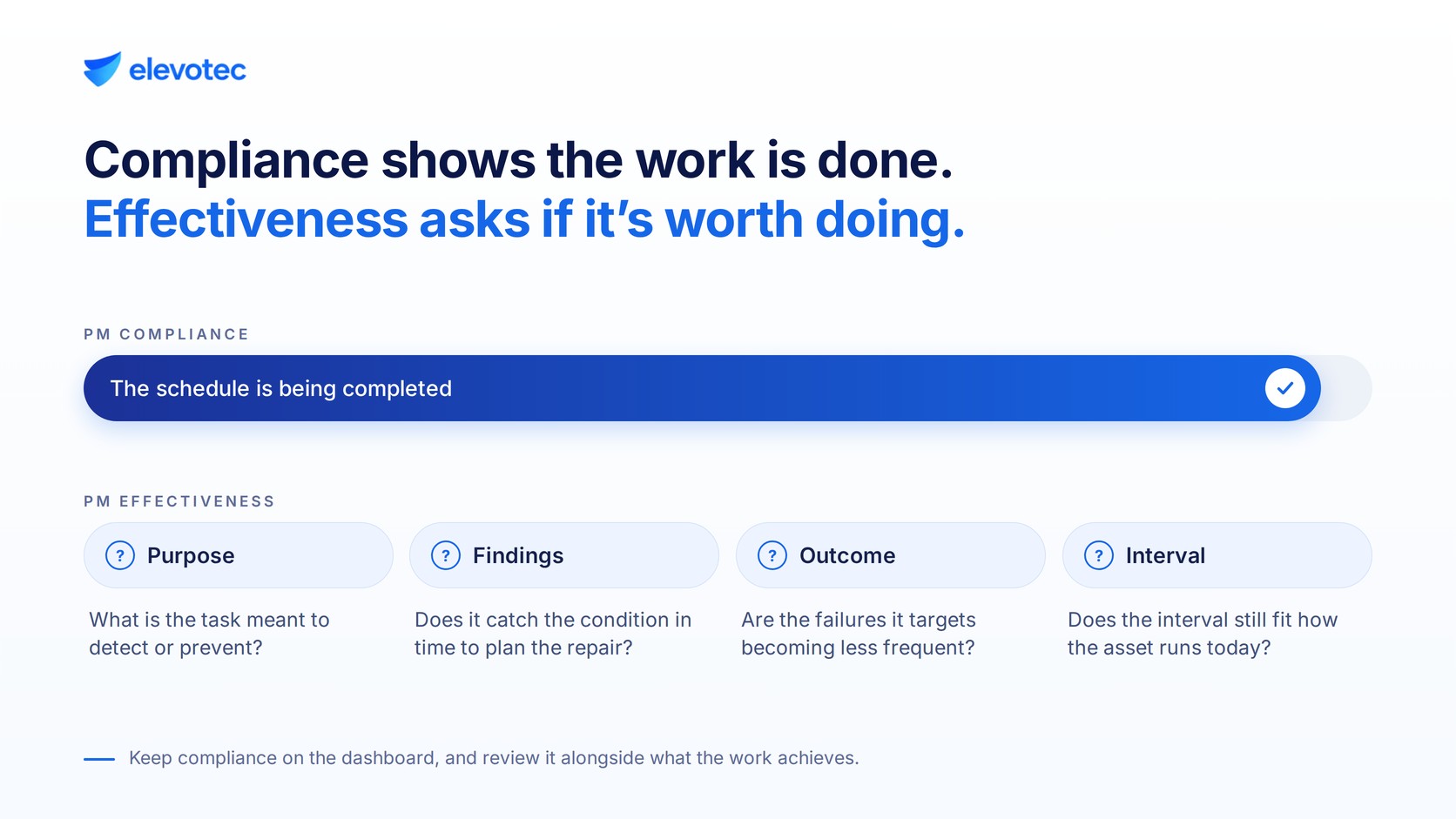
Judging whether the inspection is effective takes different questions. Has it picked up developing degradation before a failure? When it found something, was there enough lead time to plan the repair? Have the failures that justified the inspection in the first place become less frequent, and does the interval still suit how the gearbox runs today? These are harder to turn into a single percentage, which is part of why execution metrics get so much attention, and they sit much closer to the reason the task exists.
Every PM should have a purpose someone can state plainly. An inspection looks for a specific failure condition, and a functional test proves that a protective device will work when it is needed. When nobody can say what risk a task controls, it is due for review. The same applies to its frequency, which should rest on manufacturer guidance, regulation, engineering analysis or documented operating history. An interval that exists because it was migrated from the previous system deserves less confidence.
Excess preventive work creates pressure elsewhere
Maintenance capacity is finite, and every preventive task uses some of it. PM is often discussed as though adding a task is always the cautious choice. For a single inspection that reasoning holds, and across a large asset base it produces a program bigger than the team can realistically deliver. An inspection that has found nothing in years keeps a technician away from corrective work, and components replaced on very conservative intervals often come out with useful life still in them.
Eventually the schedule gets large enough that supervisors start making informal calls whenever production pressure rises. Some tasks get pushed back again and again, and some PMs are treated as optional while sitting in the system exactly like work nobody would choose to defer. The supervisors’ judgment may well be sound. The concern is that the organization is relying on it to make up for a formal schedule that has not kept pace with what the team already knows.
The appropriate trigger depends on asset behaviour
Calendar-based maintenance still suits a large share of industrial work, including statutory tasks, lubrication, consumables and wear patterns that are well understood. It struggles when the calendar stays fixed and utilization does not. Two similar machines can live very different lives, one running continuously across shifts and the other supporting intermittent production, and the same interval can mean too much work on one and too little attention on the other.
Where wear follows the work an asset does, usage makes a better trigger, whether that is run hours, cycles, starts or production volume. Condition data adds another layer by letting maintenance respond when measurable behaviour starts to change. None of this means every asset needs sensors. Plenty of equipment is well served by a simple calendar PM, highly critical assets with measurable degradation may justify condition-based work, and some low-criticality items are cheapest to run to failure. A mature program chooses by asset, operating context and the consequence of failure.
Using EAM history to challenge the schedule
A well-kept EAM already holds most of what a PM review needs. Work history shows what was done and when, failure records show what keeps coming back, inspection findings show whether preventive work is catching developing problems, and labour and material data shows what each strategy costs in capacity. Together they answer questions that experience alone struggles with, such as which tasks regularly lead to corrective work, which asset classes get plenty of PM attention and still generate emergency work, and which tasks keep getting deferred because operations cannot release the equipment.
All of that depends on documentation. If inspections are closed with minimal detail, the system records that the task happened and very little about what was seen. If failure codes are applied inconsistently, patterns are hard to spot, and if follow-up repairs are not linked to the inspections that found them, nobody can tell which PMs are catching problems early enough to matter. The EAM cannot decide whether a task is worth doing. What it can do is give experienced people far better evidence to decide with.
The next step for strong PM programs
PM compliance should stay on the dashboard, since a program that is not being executed has a clear problem and the metric makes it visible. The improvement is to stop asking one number to describe the health of the whole strategy, and to review it alongside what the work achieves, such as whether repeat failures are falling on heavily maintained assets and whether findings turn into planned work before failure.
Over time, that shifts the goal from completing as much of an inherited PM library as possible to running a program where the scheduled work is worth completing. It takes more judgment than a compliance target, and teams tend to trust the schedule more because the link between the work and the equipment is easier to see.
At Elevotec, we work on this from the maintenance and operations side as well as the technology side, looking at whether the schedule, the asset information and the work practices around it are producing the reliability the business needs. For teams that already run strong PM compliance, it is usually the most rewarding place to look next.