

Spare parts are one of the few maintenance costs that show up clearly on the balance sheet, which is why MRO inventory attracts reduction targets more reliably than most maintenance spend. The logic is easy to follow. Inventory is capital that earns nothing, most storerooms hold items that have not moved in years, and a lower inventory value is an improvement anyone can measure straight away.
The catch is that a spare part exists to shorten a failure, so its value depends on what happens when it is missing. MRO inventory is a reliability decision expressed in financial terms, and a reduction program that judges it on carrying cost alone can deliver a smaller storeroom and a more expensive operation.
Two problems that often get confused
Most storerooms carry too much of the wrong material and too little of the right material at the same time. The first problem builds up over years: parts kept after the equipment they served was replaced, project leftovers that were never returned or written off, the same component held under different descriptions, and minimum levels raised during a bad stretch and never revisited.
The second problem is structural. Critical components with long lead times often go unstocked because their usage history is low, and an item used once every four years barely registers in a consumption-based review, even when its failure would stop production for weeks. A reduction program driven by usage data tends to fix part of the first problem and make the second worse, because the most consequential spares in an operation are almost always slow movers. What matters is what happens when a part is needed and unavailable.
Availability is more than a quantity on hand
A quantity in the system does not mean a job can go ahead. The part may be the wrong revision for the equipment as it is now configured, or it may have been opened and returned to stock without inspection. The hardware needed to fit it may sit under a separate record or not be held at all, and in a large storeroom an item sitting somewhere other than its recorded location is as good as missing. Each of these ends the same way, with the system showing the part as available, the technician unable to finish, and the job rescheduled while someone investigates.
Practical availability means the item is right for the asset, usable in its current condition, findable where the system says it is, and accompanied by whatever else the job needs. A cycle count confirms the quantity and little else, so organizations that measure inventory accuracy on counts alone tend to overstate how well the storeroom supports the work.
Criticality should drive stocking decisions
A stronger basis for stocking is the consequence of the part being unavailable when it is needed. That means weighing what stopping the equipment costs in production or compliance, how long the part would take to get, whether a redundant asset or workaround can keep the function running, and whether failure is predictable enough to order ahead.
Applied consistently, those questions lead to conclusions a usage review would miss. Some slow movers should be held permanently because their lead time exceeds any acceptable downtime, while some fast movers can be held in smaller quantities because they are easy to get locally. Some parts belong under a supplier agreement rather than on the shelf, and some need not be held at all because the equipment can tolerate the wait. The resulting inventory may or may not be smaller, and the reason for every item in it can be explained, which is a far stronger starting point for any conversation about working capital.
The data problem underneath the inventory problem
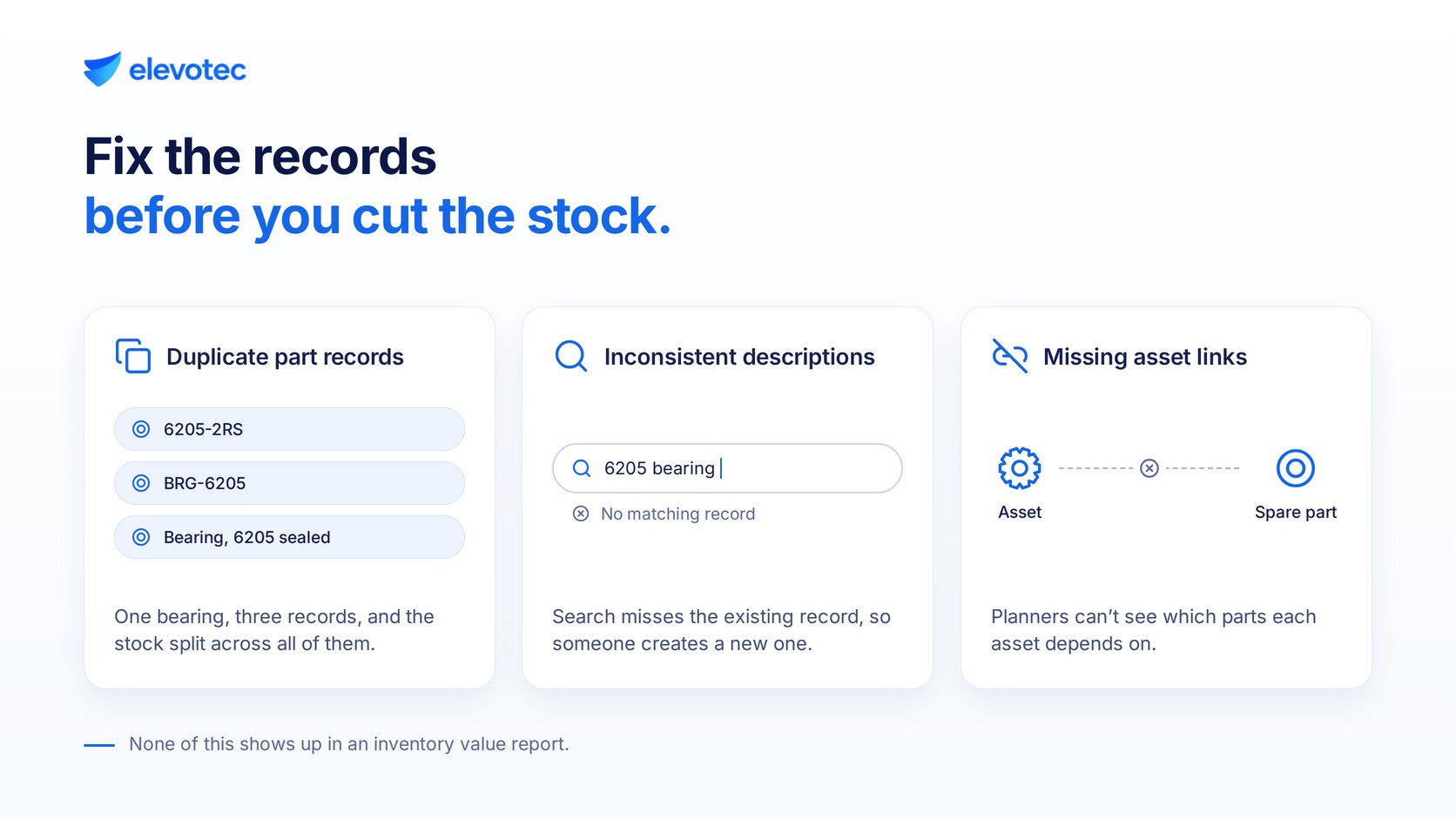
Most MRO inventory difficulties turn out to be data difficulties. Duplicate part records are close to universal in any operation that has been running for a while. The same bearing exists under a manufacturer number, an internal number and a description typed by someone who could not find the existing record, so stock is split across the entries, minimum levels are set separately, and reports show three slow movers where one moderately active item exists.
Inconsistent descriptions make it worse, because unreliable search is the main reason duplicates get created in the first place. Missing links between parts and assets are the third common gap. With an incomplete bill of materials, a planner cannot easily see which components an asset needs, and stocking decisions get made without a clear view of what depends on them. None of this shows up in an inventory value report, and all of it affects whether the storeroom supports the work, which is why record quality has to come before any reduction decision.
Obsolete stock needs an owner
Every established storeroom holds material that will never be used, left behind by replaced equipment, changed processes, superseded components and projects that never went ahead. It rarely gets removed, because removal means someone has to accept the write-off, while keeping it costs only space and reporting clarity. So it stays, and it distorts every later analysis of what the storeroom actually contains.
Finding it is usually the easy part, since it tends to be material tied to retired assets, items with no movement over a long period and no criticality case, or components superseded by an engineering change. Clearing it takes a defined process, an approval path and acceptance that the cost was incurred when the material was bought, rather than when it finally leaves the record.
What the system should support
A capable EAM environment holds the information these decisions need. Consumption history shows what has actually been used, asset linkage shows which equipment depends on which components, work order history connects parts to the jobs and failures they supported, and lead time and supplier data shows whether an item needs to be held at all. Octave Attune EAM includes functionality for exactly this, covering stocking level determination, storeroom management, requisitioning and goods receipt, alongside min and max reorder control.
The system will not decide which risks the operation should carry. What it can do is make sure that whoever decides is working from consumption history, asset relationships and lead times, instead of an inventory value report and an assumption.
Reducing inventory without adding downtime
Inventory reduction is a legitimate goal, and capital tied up in obsolete stock could be put to better use. It turns counterproductive when it is run as a financial exercise separate from reliability, because a storeroom optimized on carrying cost alone will eventually be judged on something else, such as the downtime caused when a critical component with a fourteen-week lead time was removed because it had not moved in three years.
A more useful test is whether the reason for holding each item can be stated, and whether the items whose absence would do the most damage are the ones being protected. At Elevotec, we treat MRO inventory as part of maintenance strategy, because stocking decisions and reliability outcomes are the same decision seen from two directions. The goal is a storeroom the maintenance team can rely on, at a level of investment the business can defend.