
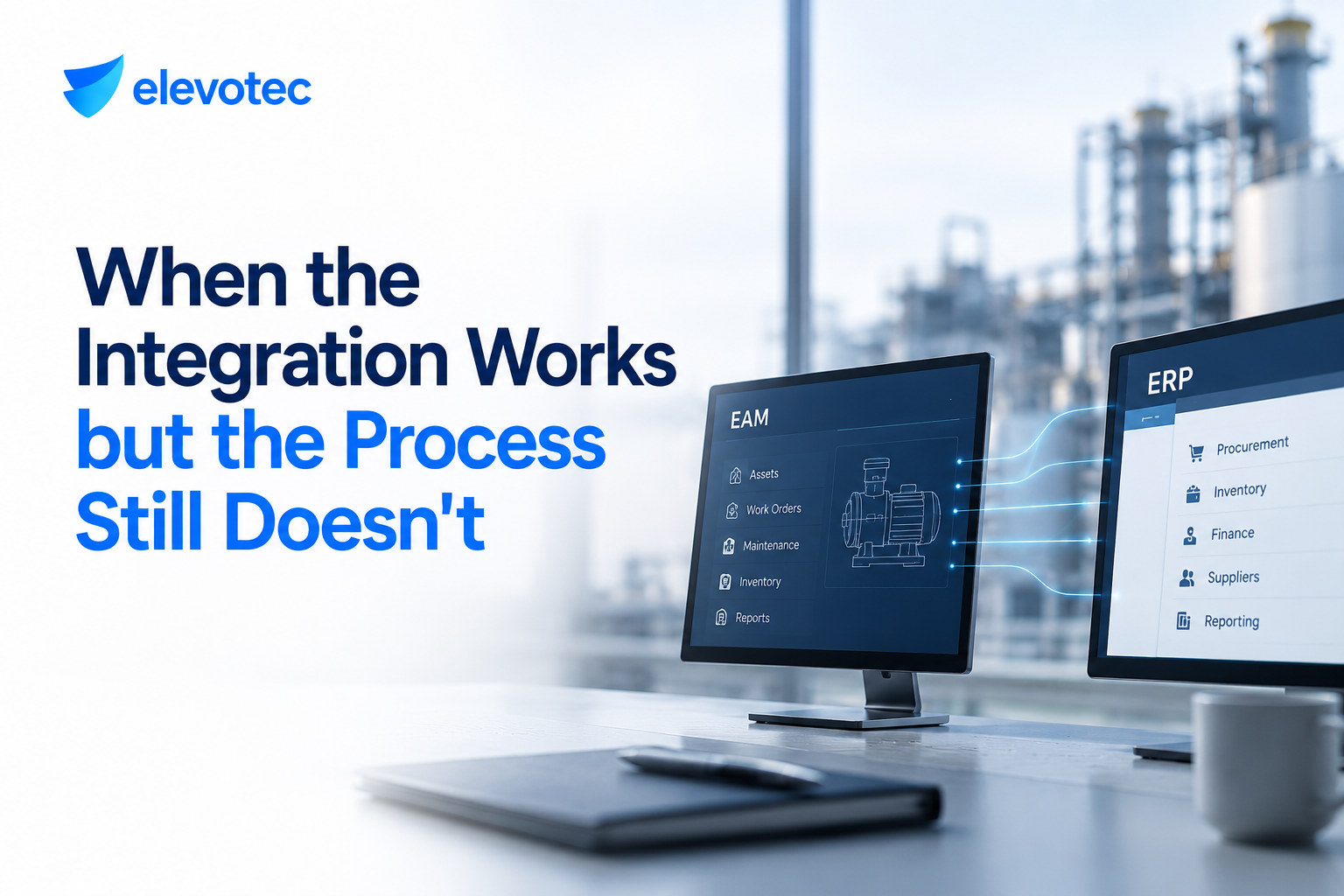
Integration testing confirms that information moves correctly between systems. It does not confirm that the organization understands what to do with that information once it arrives, who is accountable when it is wrong, or what happens when a transaction fails and two departments each assume the other is handling it.
That distinction becomes visible several months after go-live, when the integration has stopped being a project and become part of ordinary operations.
A part description is corrected in one application and remains unchanged in another. Finance and maintenance produce different cost figures for the same asset. A transaction fails and ownership of the correction is unclear. An automated process still requires someone who understands both systems to explain what happened before anyone is willing to act on the result.
In most of these cases the interfaces are working exactly as designed. What was never defined with the same precision is the process surrounding them.
For asset-intensive organizations connecting Octave Attune EAM with ERP, procurement, finance and production systems, this is the point at which integration becomes more than a technical exercise. Moving information between systems is one part of the work. The larger objective is ensuring that responsibilities and decisions around that information become clearer once the connection exists, rather than more difficult to trace.
Ownership has to be defined at transaction level
Every integration project reaches a discussion about which application is the system of record. The question appears straightforward until the business process is examined in detail.
An ERP owns financial data, suppliers and purchasing transactions. An EAM owns maintenance execution, equipment history, inspections and work status. Control systems hold live information on equipment condition. Other applications contribute engineering, inventory, planning and reporting data.
At that level, agreement is easy to reach. Difficulty appears one level below it.
If an asset description changes, where should that change originate? When maintenance creates a requirement for a part, which system controls the transaction at each stage? If inventory quantities differ between applications, where is the correction made? If equipment has been retired in the EAM but remains active elsewhere, who owns the decision and who owns the data change?
These questions can appear secondary during design. They become considerably more significant once thousands of transactions are moving through the environment each month and multiple departments are making decisions from them.
Where ownership is unresolved, integration can allow inconsistency to travel faster than it did before. Information moves automatically while the underlying disagreement about which version is correct remains in place. Users compensate in the only way available to them: verifying against a second system, confirming by email, or maintaining a local record outside the integrated process.
The result is an environment that has removed some manual data entry while leaving the original source of uncertainty untouched.
Successful integration work therefore has to extend beyond field mappings and interface design. The organization needs to establish which system owns which decision, where changes originate, and what users should do when information does not reconcile as expected.
The exception path deserves as much design attention as the standard one
Integration design naturally concentrates on the expected sequence. A requirement is created, information moves, a transaction is generated, status returns, and the process continues.
That sequence has to work. It also represents a smaller proportion of activity than most designs assume.
Supplier records become inactive. Part numbers are superseded. An asset exists under slightly different structures in two systems. A purchase order is cancelled after maintenance has revised its plan. A work order is reopened. Equipment is relocated. A transaction fails overnight and is not identified until someone looks for the result several days later.
Across the operating life of an integrated environment, these are routine events rather than unusual ones. The quality of the integration is determined substantially by how the organization handles them.
Where the design accounts for exceptions, responsibility is visible. Users know whether a correction belongs in the EAM, the ERP or another application. The cause can be established without a technical investigation on each occurrence, and once resolved the transaction resumes rather than being rebuilt manually from the beginning.
Where that structure is absent, users develop their own. A supervisor learns which screens require checking after particular transactions. Someone maintains a reconciliation spreadsheet. Maintenance contacts purchasing directly because the electronic status does not provide sufficient confidence to act on. One technical resource becomes the informal interpreter for anything unfamiliar.
An automated process gradually develops a manual operating layer around it.
The interface may continue to appear healthy under technical monitoring. The people working with it daily will hold a more accurate view of how effectively it is performing.
Operational data requires judgment before it becomes maintenance work
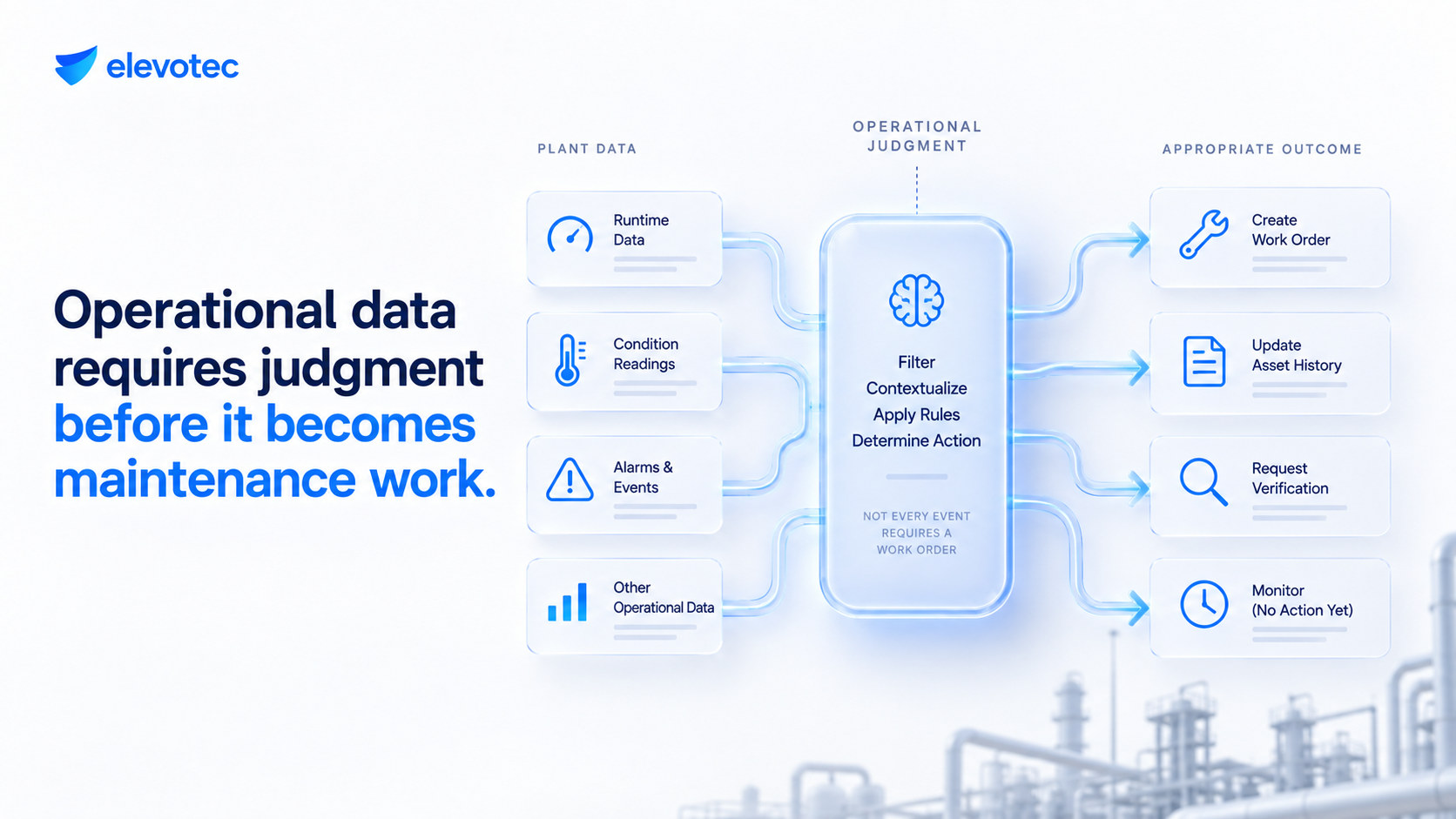
The same principle applies with greater force when an EAM is connected to plant data.
There is clear value in allowing runtime, condition readings, alarms and other operational information to influence maintenance activity. Teams can respond to asset behaviour rather than relying entirely on calendar schedules or on issues being identified during routine rounds.
The difficulty lies in determining which information warrants action.
A production environment generates a substantial volume of events. A maintenance organization does not require a comparable volume of work orders. Where every threshold crossing produces maintenance activity, the organization has transferred a source of operational noise into the system that was intended to reduce it. The connection is technically successful while the maintenance team is left to sort work that does not merit equivalent response.
Effective integration requires an operational decision positioned between the signal and the work.
A condition may need to persist for a defined period before an inspection is justified. One asset may require a different threshold from an identical asset because its operating role carries greater consequence. Some events should generate immediate work; others should update asset history or prompt a technician to verify what is occurring.
Those determinations cannot be made from an integration specification. They depend on an understanding of the equipment, the consequences of failure and the way the operation runs in practice.
This is where technical integration capability ceases to be sufficient on its own. The people designing the process require enough maintenance and business understanding to define what should happen after the information arrives.
Measure the integration by the work it removes
There is a practical way to assess an integration once the implementation team is no longer involved.
Examine the work that people no longer perform.
If maintenance continues to enter the same information into two applications, value remains unrealized. If supervisors still export separate reports before a monthly review and reconcile them manually, the connected environment has not delivered the clarity it was intended to create. If a purchasing transaction moves electronically but still requires routine follow-up calls to establish its position, the process is only partially automated.
Effective integration removes handoffs. Information appears where it is required without being recreated. Status is visible without contacting another department. Maintenance requirements move into purchasing and financial processes without re-entry. When a transaction fails, the accountable parties can understand the exception and respond without recourse to the original implementation team.
These outcomes provide a more meaningful measure of integration quality than interface availability. An interface can remain technically available almost continuously while supporting a process that is unnecessarily difficult to work within. The business value derives from the reduction in friction around the work, not from demonstrating that two applications can exchange information.
The design has to accommodate future change
Enterprise environments do not remain static after go-live.
ERP platforms are upgraded. Sites are added. Asset structures expand. Procurement processes evolve. Equipment is replaced. Business units are acquired. Software releases introduce new capability, and the people who understood the original design move into other roles.
An integration built on undocumented custom logic becomes progressively more difficult to modify with each of these events. Organizations can eventually reach a position where reasonable improvements are approached with caution because the full set of dependencies on the current configuration is no longer understood.
The environment appears stable. In practice, it is stable because it is not being touched.
A stronger design keeps responsibilities and dependencies explainable over time. Ownership remains clear. The direction of significant information flows can be described by people other than the original architects. Customization is applied deliberately rather than by default, and the organization understands what a change to an underlying business rule means for the integration that depends on it.
This matters because an integration rarely remains the property of a single implementation project. Once it forms part of the operating environment, it has to survive several years of business and technology change. The standard is therefore higher than reaching a successful go-live.
Begin with the operating process
Before determining how two systems should communicate, it is worth working through the business process without reference to the technology.
Where does the information originate? Who is accountable for its accuracy? Which function requires it next, and what decision will be made from it? Which information is currently entered more than once? Where are records being reconciled manually? What occurs when a transaction does not follow the expected path? Which steps consume time without providing meaningful control?
These questions identify the real integration requirement more reliably than beginning with an inventory of available interfaces. They also distinguish between a problem that genuinely requires system integration and a process that first requires definition.
Connecting two poorly defined processes improves neither. It allows uncertainty in one area to reach another more quickly.
Where the operating model is understood first, the technology becomes easier to design around it. Each system performs the function it is best suited to perform, information moves for a defined purpose, exceptions carry ownership, and users understand where corrections belong.
Final thoughts
Industrial organizations have more opportunity to connect their systems than at any previous point, and there is substantial value in doing so effectively.
Maintenance does not operate independently of purchasing, inventory, finance and production. A properly integrated EAM environment reduces manual effort, improves information quality and shortens the distance between an operational requirement and the business response to it.
The value, however, is determined by what happens beyond the connection itself. The meaningful test begins when transactions stop being test cases and become routine business activity. Ownership, exception handling, process clarity and operational judgment then determine whether the integration simplifies the organization or provides a more efficient means of moving unresolved problems between systems.
Elevotec approaches EAM integration as part of the broader operating environment, because the software represents one component of the outcome and rarely the decisive one. Understanding the business process, the people who depend on it and the systems surrounding the EAM is what allows a technical connection to produce something useful in practice.
In some cases the integration problem is genuinely technical. In others, the technology is performing exactly as specified while the process around it has not received the same attention.
Identifying which of the two applies can save an organization years of working around a connection that was technically successful without resolving the problem it was built to address.