
ELEVOTEC
OEM Pressure Is Reshaping Asset Governance in Tier 1 Manufacturing
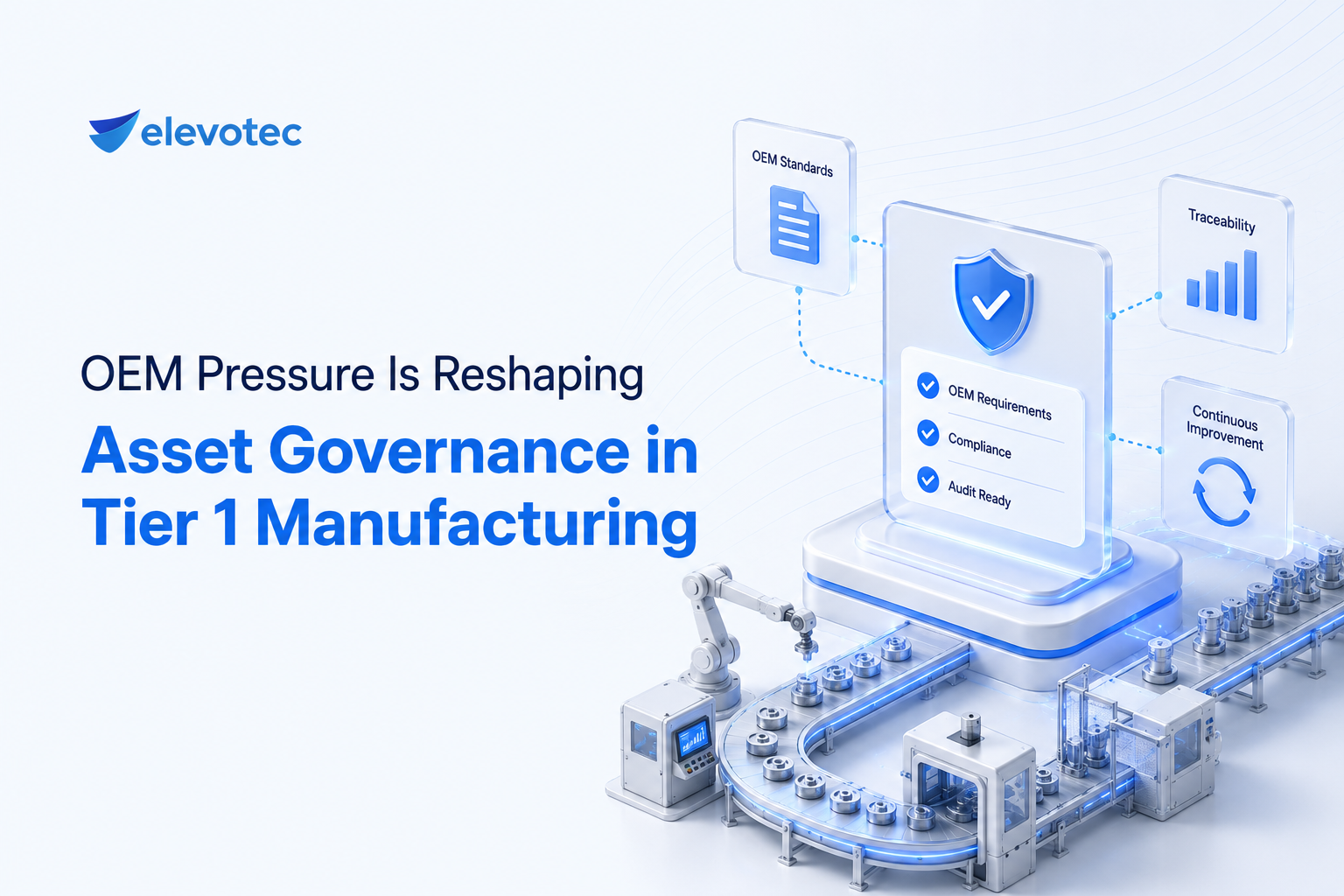
In 2026, reliability is no longer an internal metric for automotive suppliers.
It is a contract variable.
Across North America and Europe, OEMs have tightened expectations around uptime, traceability, and operational accountability. Production stability is no longer assumed. It must be demonstrated.
For Tier 1 manufacturers, this changes the role of asset management entirely.
Maintenance performance is no longer measured only by internal KPIs. It increasingly influences supplier credibility, audit outcomes, and long-term competitiveness.
This shift is subtle. But it is structural.
The New Reality for Tier 1 Operations
Most Tier 1 organizations operate across multiple facilities, often with varying levels of asset management maturity.
Some plants run structured preventive programs.
Others rely heavily on experienced technicians and tribal knowledge.
Some have EAM platforms that are partially deployed.
Others still rely on hybrid systems.
Historically, this variability was tolerated as long as production targets were met.
That tolerance is narrowing.
OEMs are asking sharper questions about:
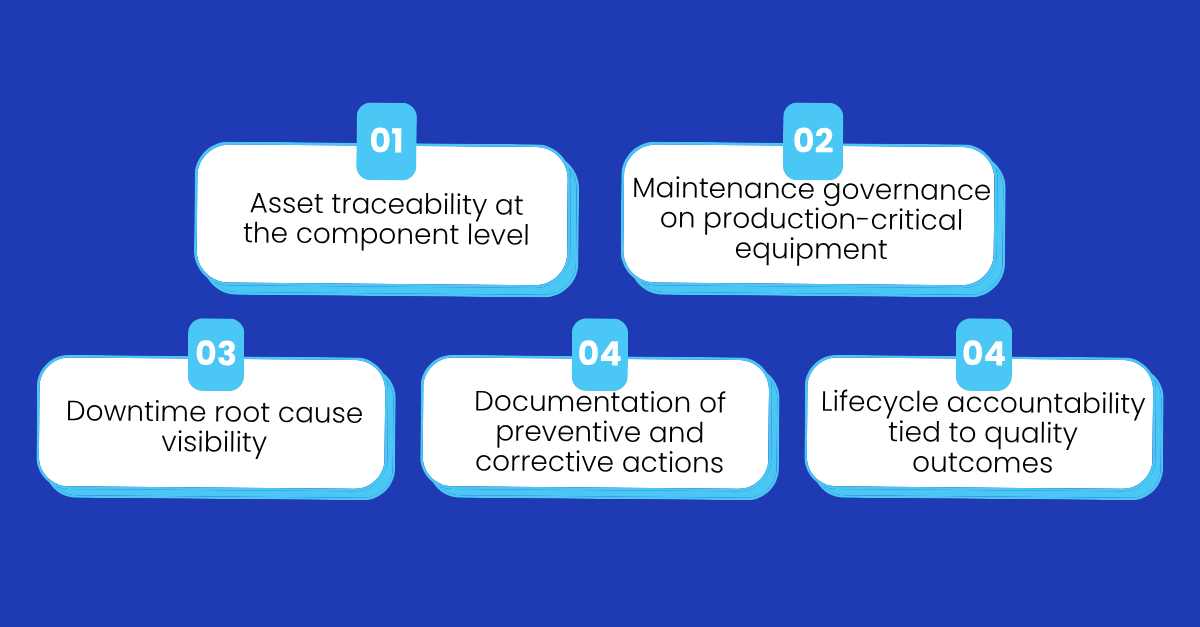
This is not about installing software. It is about proving operational control.
And proving control requires structure.
Where Exposure Quietly Builds
In many Tier 1 environments, the risk does not appear as failure.
It appears as inconsistency.
- One plant tracks downtime rigorously, another does not.
- Asset hierarchies are structured differently across sites.
- Inventory data is incomplete or misaligned.
- Preventive schedules exist but are overridden under pressure.
- Reporting is generated, but confidence in its accuracy varies.
None of these gaps are dramatic on their own.
But collectively, they weaken the organization’s ability to respond confidently to OEM scrutiny.
When an audit question arises, leadership should be able to demonstrate:
- Clear asset lineage
- Documented maintenance history
- Consistent governance standards
- Measurable reliability improvement
If that visibility requires manual reconciliation or fragmented reporting, exposure increases.
In 2026, exposure is not theoretical. It affects contract renewal, production allocation, and long-term supplier positioning.
Asset Traceability Is Now a Competitive Discipline
Traceability in automotive has long focused on parts, batches, and quality records.
What is becoming clearer is that equipment reliability and maintenance governance are directly tied to those same outcomes.
If a production-critical asset fails repeatedly without structured root cause management, quality variability follows.
If preventive maintenance is inconsistently executed, performance drift becomes invisible until output suffers.
If inventory and spare parts governance are weak, recovery time extends unnecessarily.
These are not maintenance inconveniences.
They are competitiveness risks.
Organizations that treat asset traceability as an integrated discipline gain an advantage:
- Equipment hierarchy aligned across sites
- Standardized work management processes
- Structured root cause tracking
- Inventory accuracy tied to uptime objectives
- Executive-level reporting grounded in operational reality
This level of maturity does not happen through configuration alone.
It requires operational design.
Why Many Tier 1 Asset Programs Plateau
The common pattern is familiar.
An EAM platform is introduced with strong intent.
Core modules are deployed.
Work orders are digitized.
And then progress slows.
Adoption becomes uneven across sites.
Data quality begins to drift.
Governance loses clarity under production pressure.
The system remains in place, but the expected reliability gains do not fully materialize.
This is rarely a technology limitation.
More often, it is a sequencing and governance issue.
Operational discipline must precede optimization.
At Elevotec, asset management is approached as a business capability, not a module deployment.
That means aligning asset structure, work management, and reporting standards before expanding complexity.
It means ensuring maintenance governance supports executive accountability, not just technician workflow.
It means designing for consistency across plants, not isolated success at a single site.
What Mature Automotive Asset Governance Looks Like
When Tier 1 organizations reach maturity in asset governance, the difference is visible.
Leadership can answer, with confidence:
- Which assets present the highest production risk
- How downtime trends compare across facilities
- Whether preventive compliance is stable under production load
- How inventory supports uptime objectives
- Where capital investment will reduce operational exposure
More importantly, they can demonstrate this consistency externally when required.
That is the difference between managing maintenance and governing assets.
In 2026, governance is the standard.
The Strategic Question for Tier 1 Leaders
OEM expectations are not loosening. Competitive pressure is not easing. Audit intensity is not decreasing.
The question is no longer whether asset management matters.
It is whether asset governance is structured enough to withstand external scrutiny without creating internal instability.
For some organizations, the next step is expanding an existing EAM footprint with stronger discipline.
For others, it is stabilizing fundamentals before adding complexity.
Either way, the objective is the same:
Operational certainty that can be demonstrated, not assumed.
If Tier 1 competitiveness increasingly depends on traceable, reliable production capability, the maturity of your asset governance is not a background detail.
It is a strategic position.