
ELEVOTEC
Business Intelligence in Asset Management: Turning Data into Action
Business intelligence in asset management has become essential, not because organizations lack data, but because they’re overwhelmed by it. Asset-intensive businesses collect vast amounts of operational and maintenance data, yet still experience unplanned downtime, rising costs, and reactive decision-making. Data alone hasn’t delivered better outcomes.
The problem isn’t data collection, it’s insight. When asset data lives in disconnected systems or lacks context, teams struggle to identify risks, forecast failures, or prioritize maintenance and capital investments. Business intelligence in asset management transforms raw data into meaningful insight that supports smarter, faster, and more confident decisions.
In this blog, we’ll explore how business intelligence in asset management turns operational data into actionable intelligence. You’ll learn how BI enhances visibility across asset performance, supports proactive maintenance strategies, and enables better planning and cost control. We’ll also highlight how Elevotec helps organizations unlock the full value of their asset data through integrated BI and EAM solutions.
Let’s begin!
What Business Intelligence Means in Asset Management
Business intelligence in asset management refers to the practical use of data to improve how physical assets are maintained, operated, and invested in. It goes beyond basic reporting by consolidating asset data, analyzing trends, and presenting insights in a way decision-makers can act on quickly. When implemented correctly, BI helps organizations move from reactive maintenance to proactive, performance-driven strategies.
In an asset-focused context, business intelligence combines data aggregation, analytics, visualization, reporting, dashboards, and decision-support tools into a single, connected view of asset performance.
These capabilities draw from asset-specific data sources such as maintenance history, asset condition and performance metrics, work orders, inspections, downtime events, failure patterns, and inventory or spare parts usage.
When these data points are connected, business intelligence reveals inefficiencies, highlights potential risks, and supports smarter maintenance planning, capital allocation, and operational decisions across the entire asset lifecycle. This level of clarity helps teams align operations, budgets, and reliability goals more effectively.
The Role of BI in Improving Reporting Accuracy
Accurate reporting is the foundation of effective asset management decision-making. Without reliable data, organizations risk basing maintenance strategies, budgets, and capital plans on incomplete or misleading information. Business intelligence plays a critical role in improving reporting accuracy by bringing structure, consistency, and trust to asset data.
Inconsistent Data Across Systems
Asset data often lives in multiple systems, creating discrepancies between maintenance, operations, and finance reports. BI resolves this issue by consolidating data into a single source of truth, ensuring consistency across all reports and stakeholders.
Manual Report Creation
Manually built reports increase the risk of human error and outdated information. BI automates report generation, reducing errors while ensuring reports are delivered consistently and on time.
Outdated or Incomplete Asset Records
Incomplete maintenance histories or missing asset data undermine reporting accuracy. BI platforms continuously refresh data, helping teams maintain up-to-date and reliable asset records.
Centralized Data Models
Centralized data models standardize how asset data is structured and interpreted. This ensures reporting accuracy across departments while eliminating conflicting metrics and interpretations.
Standardized KPIs and Definitions
BI enforces consistent KPIs and definitions across the organization. This alignment ensures everyone measures asset performance using the same benchmarks and criteria.
Accurate reporting strengthens confidence in decisions at every level, from maintenance supervisors to executive leadership. Business intelligence ensures asset data remains trustworthy, actionable, and aligned with organizational goals.
Turning Operational Data Into Actionable Insights
Accurate reporting is only the starting point, real value comes when data drives action. Business intelligence bridges the gap between knowing what happened and understanding what needs to change, helping asset teams move from observation to informed decision-making. This shift enables organizations to proactively manage risk, cost, and performance.
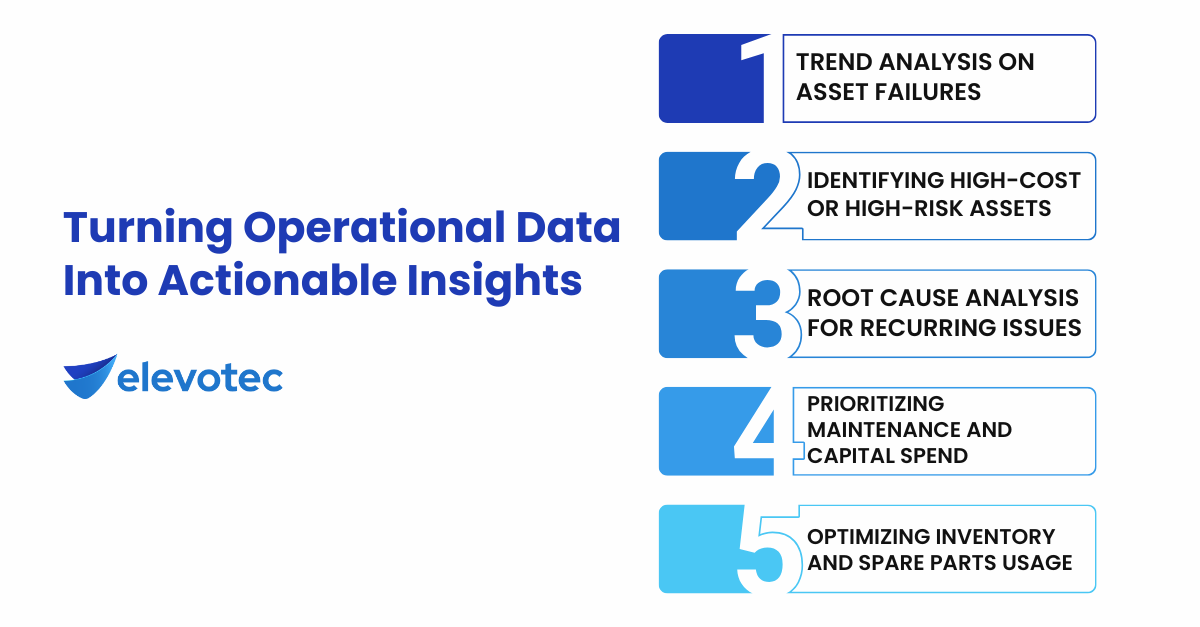
Trend Analysis on Asset Failures
- BI analyzes historical failure data to uncover patterns and trends over time.
- These insights help teams anticipate recurring issues and address underlying problems before they escalate into major disruptions.
Identifying High-Cost or High-Risk Assets
- Not all assets carry the same operational or financial risk.
- BI highlights assets with high repair costs, frequent failures, or critical operational impact, allowing teams to focus resources where they matter most.
Root Cause Analysis for Recurring Issues
- Recurring breakdowns often signal deeper issues.
- BI supports root cause analysis by correlating failure events with maintenance history, operating conditions, and inspection data.
Prioritizing Maintenance and Capital Spend
- BI provides visibility into asset performance and lifecycle costs.
- This insight supports smarter decisions around maintenance prioritization and capital investments.
Optimizing Inventory and Spare Parts Usage
- Excess inventory ties up capital without delivering value.
- BI reveals spare parts with low usage or poor turnover, enabling better inventory planning.
Business intelligence transforms operational data into clear, actionable insight. It doesn’t just show what happened, it helps explain why it happened and what actions will drive better outcomes.
BI-Driven Risk Assessment in Asset Management
Managing asset risk requires more than historical reporting, it demands foresight. Business intelligence enables organizations to assess risk proactively by analyzing asset condition, performance trends, and operational impact. This approach strengthens reliability, safety, and long-term planning across asset portfolios.
- Failure Risk Scoring: BI evaluates historical failures, condition data, and usage patterns to assign risk scores to individual assets. These scores help teams identify which assets are most likely to fail and require immediate attention.
- Asset Criticality Analysis: Not all assets carry the same operational or safety risk. BI supports criticality analysis by combining asset function, failure impact, and operational dependency to prioritize maintenance and mitigation efforts.
- Safety and Compliance Monitoring: Regulatory compliance and safety performance depend on accurate, timely data. BI tracks inspection results, incidents, and compliance metrics to help organizations identify gaps before they lead to violations or safety events.
- Lifecycle Cost Forecasting: BI analyzes maintenance, repair, and operational costs across an asset’s lifecycle. This visibility supports informed decisions around repair-versus-replace strategies and long-term capital planning.
- Capital Replacement Planning: Aging or underperforming assets introduce hidden risk. BI highlights assets nearing end of life, enabling data-driven replacement planning that reduces disruption and financial exposure.
BI-driven risk assessment transforms asset management from reactive problem-solving to proactive risk control. With business intelligence, organizations can reduce failures, improve safety outcomes, and plan asset investments with greater confidence.
How Elevotec Uses BI to Drive Asset Performance
Business intelligence in asset management is most effective when insights directly influence daily decisions and long-term strategy. Elevotec applies BI as a performance enabler, connecting asset data to measurable business outcomes rather than isolated system reports. This approach ensures data supports action at every level of the organization.
Elevotec integrates BI seamlessly with enterprise asset management and ERP platforms, creating a unified view of asset performance, maintenance activity, and financial impact.
Role-based dashboards are designed for executives, managers, and technicians, delivering the right insights at the right level of detail. Strong data quality and governance practices ensure information remains accurate, consistent, and trusted across systems.
BI metrics are aligned with operational efficiency, reliability, cost control, and risk reduction, so insights reflect real business priorities, not just system outputs.
Elevotec doesn’t just deploy BI tools. It ensures insights are operationalized, enabling teams to act with clarity, confidence, and purpose to continuously improve asset performance.
Final Thoughts
Business intelligence in asset management is the bridge between data and decisions. When asset data is accurate, connected, and actionable, organizations gain more than visibility, they gain control over risk, performance, and cost. BI transforms information into impact by enabling trust, foresight, and smarter use of resources.
To move from insight to execution, explore how Elevotec helps organizations operationalize business intelligence within existing asset and enterprise systems.
Schedule a BI strategy session, assess your asset data maturity, and discover how BI can unlock hidden value across your asset portfolio.