
There is a conversation that happens more often than most organizations would like to admit.
A maintenance leader or operations director is asked how the EAM is performing. The answer comes back: “It’s fine. We use it for work orders. The team logs their time in it. We run our PMs through it.”
Then comes the follow-up.
Can you pull your true cost of maintenance per asset class? Can you see which assets are trending toward failure before they get there? Can you tell me what your top ten contributors to unplanned downtime were last quarter and why they actually happened?
A pause. Then some version of: “We’d have to put that together manually.”
This is the quiet reality in a significant number of organizations that have already made a serious EAM investment. The platform is live, licensed, and technically operational. And it is being used to do roughly twenty percent of what it is capable of.
The investment was real. The return is not.
How organizations end up here with entirely rational decisions
It is easy to look at this situation from the outside and wonder how it happens. From the inside, the path is entirely logical.
Implementation projects have deadlines, budgets, and very clear finish lines. The pressure at go-live is to get the system operational, get users logging in, and get basic processes running through it. That pressure is legitimate. Getting a complex EAM live across a large asset-intensive operation is a real achievement and anyone who has done it knows how much work it requires.
But go-live is not value delivery. It is the beginning of the opportunity to deliver value.
What happens in the months after go-live determines whether the investment compounds into a genuine operational capability or plateaus at basic functionality. And in most organizations, the momentum that drove the implementation does not carry forward. Implementation partners move on. Internal champions get absorbed back into operational demands. The system runs. Nobody is actively pushing it further.
The platform has sophisticated capabilities. The organization has increasingly basic usage habits. And because the floor-level functionality is sufficient for daily operations: work orders are managed, PMs are running, the immediate need is being met, there is no visible crisis demanding a response.
The gap is invisible precisely because the system is working well enough that nobody is asking whether it could be working significantly better.
Until margins tighten. Until a capital request stalls because the asset condition data isn’t there to support it. Until a failure happens that, in retrospect, the system had enough data to anticipate but nobody was looking at it the right way.
Then the gap stops being invisible.
What the gap actually costs, and why it doesn’t appear on any report
There is a temptation to frame low EAM utilization as a licensing efficiency problem. The math on wasted license cost can be uncomfortable enough. But it understates the real cost considerably.
The actual cost of underutilizing a serious EAM is not what was spent on software that isn’t being fully used. It is what the organization continues to spend on problems the software was built to prevent.
Unplanned downtime that condition monitoring and trend analysis would have flagged weeks earlier. Reactive maintenance spend that planned approaches would have reduced. Capital replacement requests that cannot be defended because the asset condition data was never structured well enough to tell the story. Inventory carrying costs driven by parts management that never moved beyond basic stocking because the demand intelligence to optimize it was never developed.
These costs are real. They simply do not appear on a line item that says “cost of not using our EAM properly.”
They appear as overtime. Emergency procurement. Reactive repair bills. Capital approvals that take three months longer than they should because the evidence base is manual and fragmented. Leadership meetings that spend forty minutes reconciling different versions of the same maintenance report instead of making decisions.
In a comfortable margin environment, organizations absorb these costs as operational friction and move on. In the environment most asset-intensive organizations are navigating right now: tighter margins, sharper scrutiny on capital, less room to absorb avoidable losses, that friction is becoming expensive in ways that are increasingly hard to ignore.
The three capabilities most organizations have never actually turned on
There are three areas where the gap between available EAM capability and actual utilization tends to be widest, and where the cost of that gap is most significant.
Asset intelligence over time. Most EAM environments capture maintenance history. Very few have structured that history in a way that produces meaningful asset-level intelligence. The data exists: in most cases it has existed for years, to identify which assets are trending toward higher failure frequency, which maintenance interventions are reducing failure rates, and which asset classes represent the greatest financial exposure. That analysis is rarely happening. Not because the platform cannot support it. Because the data structures, work classification discipline, and failure coding consistency needed to enable it were never fully built or have degraded since implementation.
True cost visibility. Understanding the total cost of maintaining a specific asset over its lifecycle: not just the last work order, but the full picture of labor, parts, downtime impact, and reactive versus planned spend ratio, is one of the most powerful things a serious EAM makes possible. It is also one of the least used capabilities in most environments. The reason is almost always foundational. Meaningful cost visibility requires clean asset hierarchies, consistent work classification, and disciplined cost coding. When those foundations were rushed at implementation and never corrected afterward, the analysis they were supposed to enable never materializes. The data accumulates for years. The insight never arrives.
Maintenance-driven capital justification. When a capital replacement or significant maintenance investment needs executive approval, the organizations with mature EAM environments can build a case that moves decisions. Failure frequency trends over time. Comparative cost of continued reactive maintenance versus planned investment. Projected remaining useful life based on actual condition history rather than manufacturer estimates. That evidence set is what turns a capital request from a judgment call into a defensible business decision. Most maintenance teams are still presenting these requests based on experience and instinct: not because their judgment is wrong, but because the EAM was never used deeply enough to produce the data that would support it. The result is requests that stall, get reduced, or get approved too late.
This is not a technology problem and pretending otherwise is expensive
It is worth being direct here because the wrong diagnosis leads to the wrong response.
Organizations stuck at basic EAM utilization frequently assume the solution is more technology. Another integration. A new analytics layer. An additional module. Sometimes those investments are genuinely appropriate. More often, they add complexity and cost on top of an unstable foundation and the underlying gap remains exactly where it was.
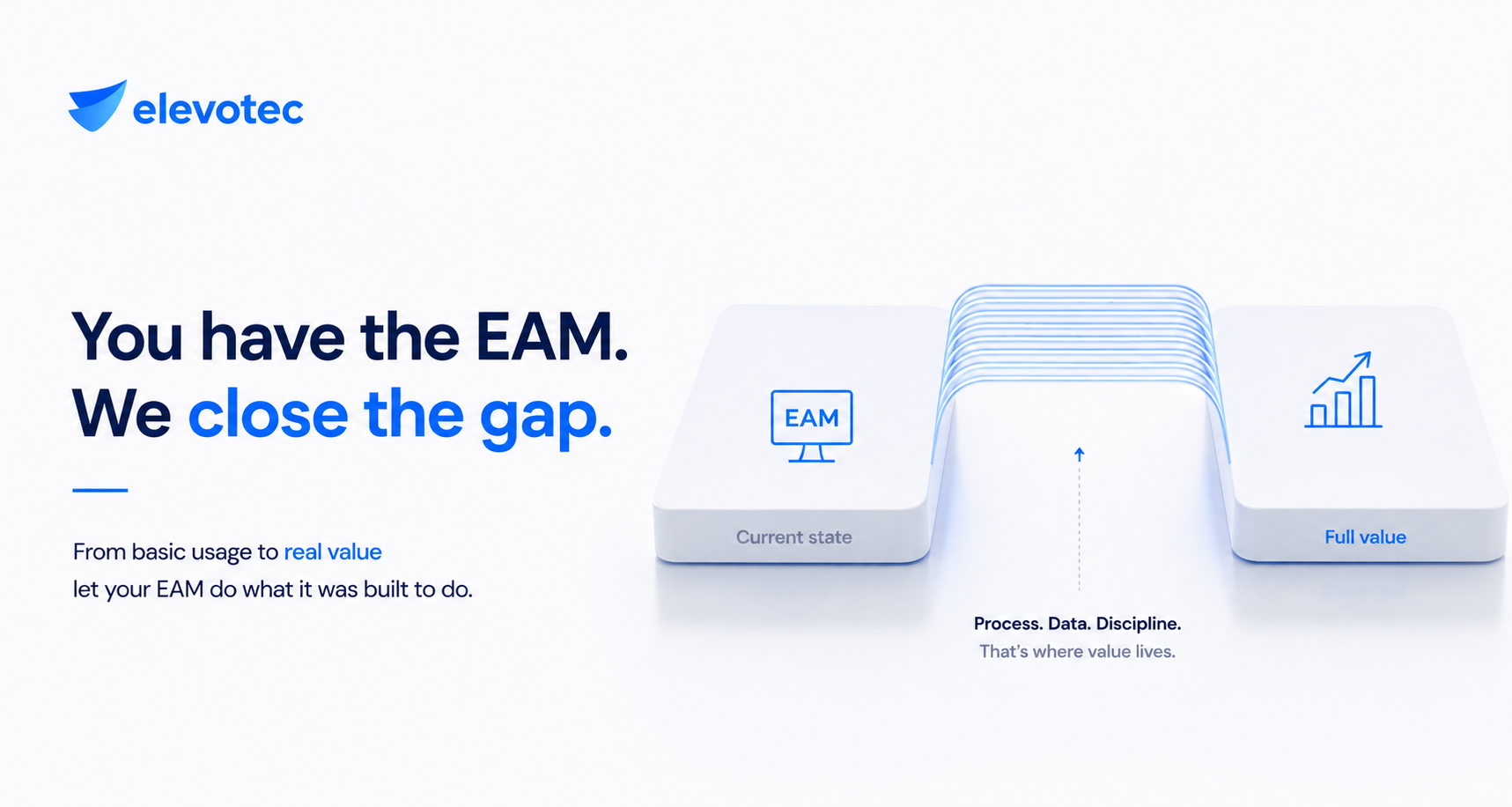
The reason most organizations are not getting full value from their EAM is not that the platform is insufficient. Hexagon EAM is a deeply capable system. The gap between what it offers and what most organizations extract from it is not a software gap.
It is a process, data, and discipline gap.
Asset hierarchies that were not built to support meaningful analysis. Work classification schemes designed for task management rather than reporting. Failure coding that was inconsistent from day one and never corrected because nobody formally owned it. A culture around work order completion that prioritized closing tickets over capturing useful information. A maintenance-to-finance connection that was never formally established because the two functions were never asked to align around common data.
These are structural problems. They require structured solutions. Not new software, but deliberate, disciplined work on the operational foundations that determine what any EAM can produce.
The organizations that close this gap do not do so by starting over. They do it by understanding exactly where the structural weaknesses are, addressing them in the right sequence, and building the operational habits around the system that allow its genuine capabilities to surface.
That work does not have a dramatic launch moment. It compounds quietly. And the return on it: over eighteen months to two years, consistently exceeds what the original implementation delivered, because it unlocks value that was already paid for.
The question that reveals where the organization actually stands
For leadership teams in asset-intensive organizations that have already made a serious EAM investment, there is one question worth asking directly.
If the CFO asked tomorrow for the total cost of maintenance per asset class over the last two years, broken down by planned versus reactive spend and correlated against downtime events: how long would it take to produce that answer, and how confident would you be in it?
If the honest answer is more than a day and less than fully confident, the system is not performing at the level the investment justified. That is not a criticism of the people running it. It is a structural diagnosis. And structural problems have structural solutions.
The gap between what the EAM is doing and what it should be doing is costing more than most organizations have formally calculated. The organizations that calculate it tend to act on it quickly, because the number is usually larger than they expected and the path to closing it is usually clearer than they assumed.
Final thoughts
Serious EAM platforms were not built to manage work orders. They were built to give asset-intensive organizations genuine operational intelligence: the kind that reduces unplanned failures, justifies capital decisions with evidence, and lets leadership make faster, more confident calls about where to invest and where to act.
Most organizations are getting a fraction of that. And the fraction they are getting, while useful, is not what they paid for.
The path to the rest of it is not another implementation project. It is an honest assessment of where the foundations are weak, a disciplined plan to address them, and the operational commitment to use the system the way it was designed to be used.
Elevotec works specifically with organizations that have Hexagon EAM in place and are not yet seeing the return the investment should be producing. Not to replace what exists. Not to add complexity on top of it. But to build the operational foundations that allow it to perform at the level it was designed for: and to make the gap between current reality and that standard visible, measurable, and closeable.
If that gap is starting to feel expensive, it probably is. And it is almost certainly more fixable than it looks from the inside.