
There is a noticeable shift happening across asset-intensive industries.
In manufacturing, automotive supply, utilities, public works, fleet, steel, and energy, asset performance is no longer being discussed as a system upgrade. It is being discussed as operational control.
That distinction matters.
For years, enterprise asset management was positioned as modernization. Today, it is being evaluated as risk containment.
Margins are tighter. Raw material volatility continues to distort forecasting. Regulatory oversight in public sector environments is increasing. OEM pressure on Tier 1 suppliers has hardened around traceability and uptime expectations. Boards are asking sharper questions about capital allocation.
In that climate, unpredictable operations are no longer tolerated.
And unpredictable operations almost always trace back to asset reliability.
The Quiet Risk Most Leadership Teams Are Carrying
Very few organizations describe themselves as reactive.
They have planners.
They have KPIs.
They have preventive schedules.
They have an EAM, or they are considering one.
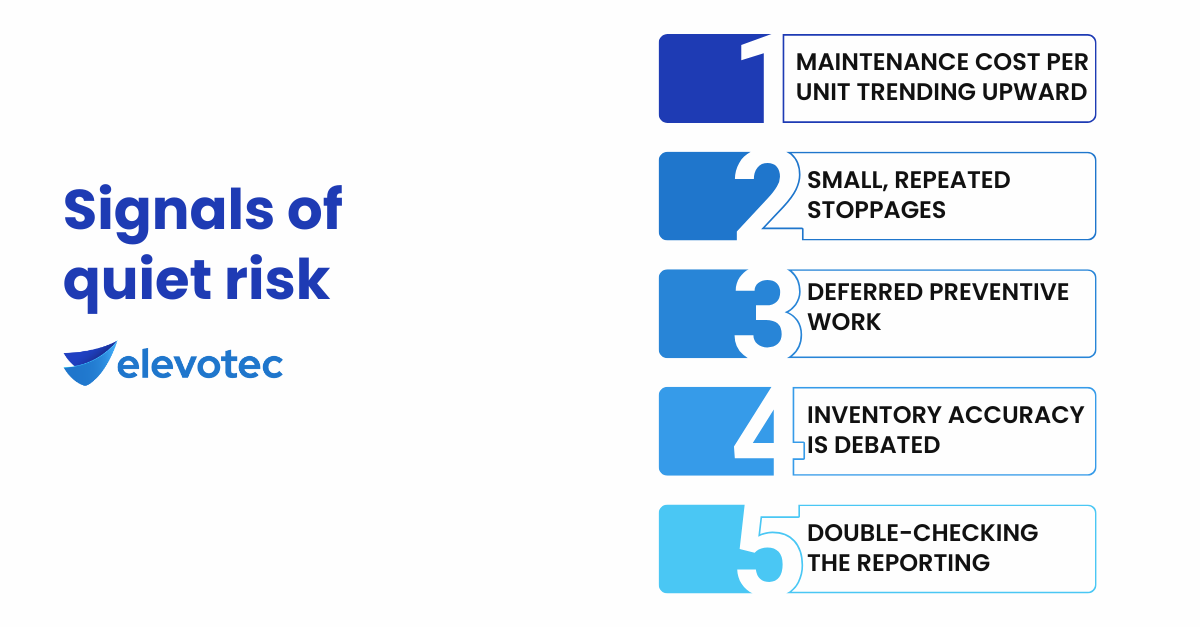
None of this feels catastrophic.
That is precisely why it persists.
Over time, these patterns do something more damaging than a single breakdown. They erode predictability.
And predictability is what executives are ultimately responsible for.
When output becomes inconsistent, planning weakens.
When planning weakens, capital becomes defensive.
When capital becomes defensive, competitiveness suffers.
That is the real business case behind asset management in 2026.
Why Many EAM Investments Fail to Change the Outcome
The issue is rarely the platform itself.
Most underperforming EAM environments share the same root cause: the system was implemented before the operating model was stabilized.
Technology was configured.
Screens were built.
Workflows were deployed.
But the fundamentals were not aligned:
- Work intake discipline was inconsistent.
- Asset hierarchies were incomplete or poorly structured.
- Inventory and materials processes were not fully reconciled.
- Accountability between operations and maintenance remained blurred.
The result is predictable. The system becomes a digital record of operational friction instead of a mechanism that removes it.
At Elevotec, we approach asset management as operational design first and configuration second.
Because without structural clarity, even the strongest platform will underdeliver.
What “Control” Actually Looks Like
When asset management matures beyond implementation and becomes a business capability, the change is measurable.
Not in abstract metrics, but in operational behavior.
You see:
- Fewer debates about whether maintenance data is accurate.
- Clear visibility into which assets drive financial risk.
- Stable planning cycles instead of weekly fire drills.
- Reduced escalation between production and maintenance.
- Leadership meetings focused on improvement, not containment.
Most importantly, downtime variability decreases. Not only the number of events, but the unpredictability of them.
That stability allows organizations to allocate capital toward growth rather than recovery.
This is what control looks like in practice.
The Implementation Question Leaders Are Quietly Asking
There are two very real concerns in 2026.
For organizations already using Hexagon EAM:
“Why are we not seeing the value we expected?”
For organizations evaluating it:
“Will this create more disruption than stability?”
Both concerns are valid. Both are justified by experience.
The answer is not speed for its own sake.
And it is not complexity disguised as sophistication.
It is disciplined sequencing.
- Stabilize work management fundamentals.
- Clean and structure asset and inventory data properly.
- Align maintenance governance with financial reporting.
- Integrate deliberately with ERP and surrounding systems.
- Build adoption through clarity, not pressure.
This is not theory. It is what determines whether an EAM initiative becomes a multi-year burden or a measurable improvement within the first operational cycle.
2026 Will Separate Mature Operators from Reactive Ones
External pressure is not easing.
Tariffs, supply volatility, governance requirements, and competitive demands are forcing organizations to examine where they are exposed.
The companies that treat reliability as a controllable discipline will stabilize faster.
The ones that continue absorbing operational friction as a cost of doing business will see that friction surface elsewhere: in margin compression, contract pressure, audit scrutiny, or capital inefficiency.
Asset management is no longer about installing a system.
It is about deciding whether operational control is intentional or incidental.
That decision is now squarely at the executive level.
If operational certainty is becoming a priority this year, the right conversation is not about features.
It is about where unpredictability is costing you the most, and how to remove it without destabilizing the organization further.
That conversation is worth having.