

By July, most organizations in asset-intensive industries are somewhere in the middle of a familiar exercise.
H1 results are in. Capital allocation for the second half is being reviewed. Finance is looking for ways to protect margin. And somewhere in that process, a maintenance or operations leader is making a case for investment: a capital replacement that has been needed for two years, a program expansion that keeps getting deferred, additional resources for a preventive strategy that still has not received adequate support.
In most organizations, that conversation goes roughly the same way each time.
The maintenance leader knows what is needed and why. The reasoning is grounded in operational experience, in what has been observed in the field, in the pattern of failures and near-misses and cost overruns that has been accumulating across quarters. The case is credible to anyone who understands the operation.
Finance does not see it that way. Finance sees a request without adequate supporting data. The numbers are largely estimates. The risk being described is probably real, but it is framed in operational language rather than financial terms. The proposed investment is not easily compared against what the asset would cost if it continued to run under the current approach. The decision comes back conservatively: defer, reduce, or approve conditionally pending better justification.
And the maintenance leader leaves the room knowing the decision was wrong while being unable to fully explain why the evidence was not there to make the case properly.
This dynamic plays out across asset-intensive industries continuously. It is not primarily a communication failure or a finance-versus-operations culture problem, though both tend to get blamed. It is a data structure problem. The maintenance case was weak not because maintenance does not matter, but because the EAM was not being used in a way that could produce the evidence the conversation required.
What the Budget Conversation Actually Requires
There is a meaningful difference between what a maintenance leader knows about an asset and what can be demonstrated to someone outside the operation.
Experience and judgment about asset condition and risk are genuinely valuable. Senior maintenance professionals with decades on a specific asset class carry real predictive intelligence about what is likely to happen and when. That intelligence is worth taking seriously.
But in a capital allocation conversation involving financial leadership, that intelligence needs to translate. It needs to appear as structured evidence connecting asset condition to financial risk in terms that can be evaluated against competing uses of capital.
That translation requires specific data to exist and be accessible. The total cost of maintaining a particular asset or asset class over the past two or three years, broken down by planned versus reactive spend and correlated against downtime events. The failure frequency trend for the assets under discussion, specifically whether it is stable, improving, or deteriorating, and across what timeframe. The cost of the most significant recent failures associated with those assets, including labor, parts, and the operational impact of the downtime that followed. A projected cost trajectory if current practices continue, compared against the cost of the investment being proposed.
None of this is complicated analysis in principle. In organizations where the EAM has been used with enough discipline to capture this information consistently, producing it for a capital request takes hours rather than weeks. The data is structured, the connections between asset records and cost data are maintained, and the report can be generated in a form that finance can evaluate directly.
In organizations where the EAM captures that maintenance occurred without capturing the full operational and financial context, the analysis has to be assembled manually from multiple sources, some of which are incomplete. The numbers arrive with caveats. Finance asks clarifying questions. The request gets deferred pending better documentation.
The outcome is not determined by the merit of the investment. It is determined by the quality of the evidence. And the quality of the evidence is determined by decisions that were made months or years earlier about how the EAM would be used.
Why the Evidence Gap Compounds Over Time
A single weak budget request, deferred or reduced because the data was not there to support it, is frustrating but manageable.
The more significant consequence is what happens over multiple budget cycles when the pattern repeats.
Maintenance investments that should have been made on the basis of asset condition data get deferred because the asset condition data was never structured well enough to support the case. The assets in question continue absorbing reactive maintenance costs. Those costs appear in the maintenance budget as operational expenses rather than as evidence of deferred investment risk. Finance sees the maintenance budget growing without clear explanation. The next capital request faces even more scrutiny.
Over time, this cycle produces a structural imbalance. The organization continues spending on reactive maintenance that a different investment decision could have prevented. The total cost is larger than the investment that was repeatedly deferred. But the causal relationship between the deferred investment and the reactive costs is never clearly visible, because the data to connect them was never captured.
This is not an unusual situation. It is the normal operating state in a significant proportion of asset-intensive organizations, particularly those that implemented an EAM with enough discipline to manage basic work order flow but without the data governance to support strategic financial analysis.
The cost of that gap is real. It simply does not appear on any report that labels itself as “cost of underusing the EAM.”
What Six Months of Asset Data Could Actually Tell You
By mid-year, most organizations with an active EAM have accumulated six months of maintenance and asset data that should, in theory, be highly informative for second-half planning.
In practice, how much of that data is being used to drive planning decisions rather than to document that activities occurred?
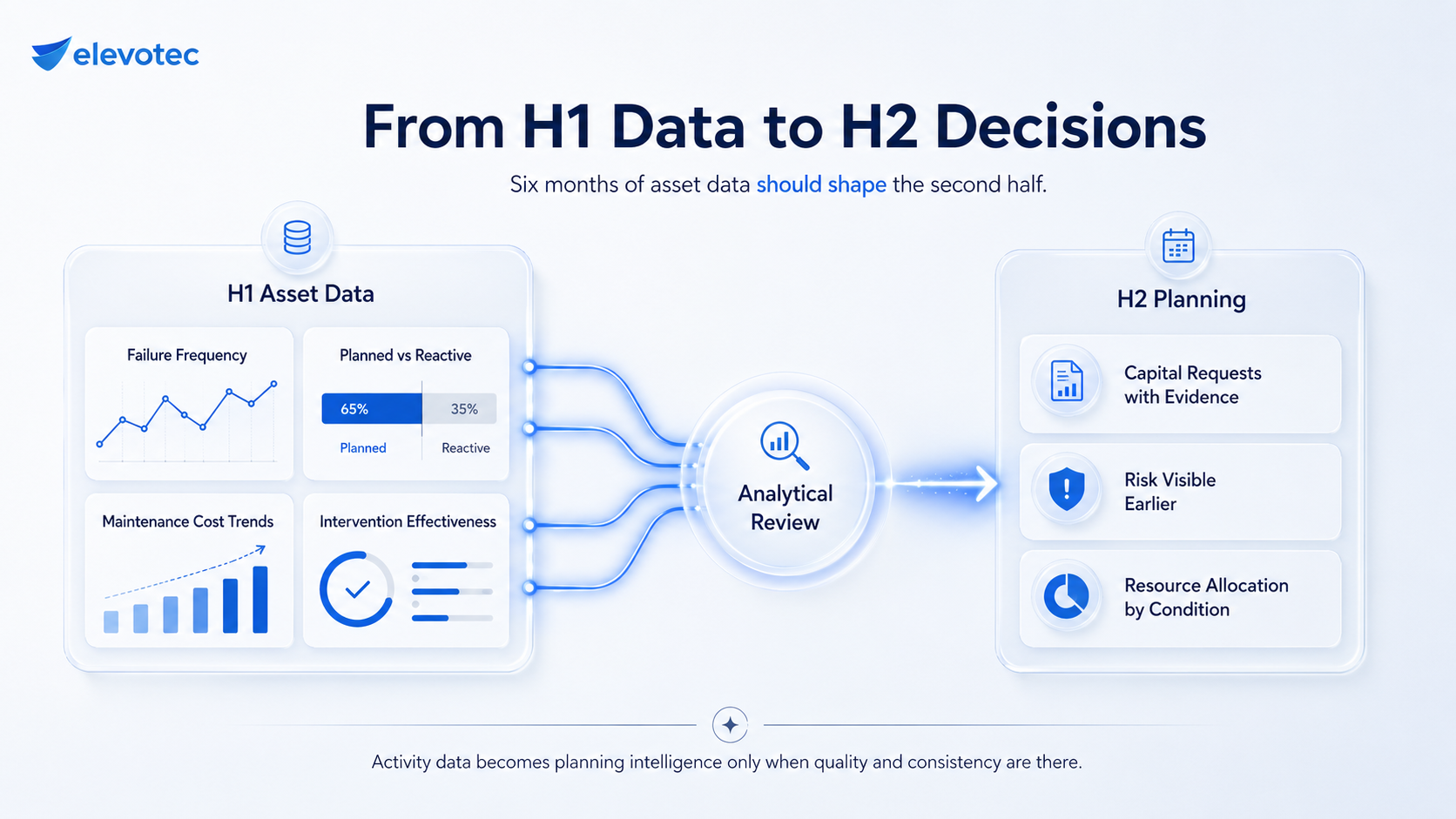
In mature asset management environments, the H1 data review is a structured analytical exercise. Which assets have shown a meaningful change in failure frequency compared to the same period last year? Which maintenance interventions have demonstrably reduced reactive work, and which have not? Where has the planned-to-reactive ratio moved in the wrong direction, and what drove that change? Which asset categories are accumulating cost faster than planned, and is that cost associated with a manageable operational pattern or a condition trend that requires a response this half?
These questions are not analytically sophisticated in the abstract. What makes them answerable is the quality and consistency of the data that exists to address them.
Organizations that have built that data quality get a second-half planning conversation grounded in operational evidence. Capital requests arrive with supporting analysis rather than supporting estimates. The assets that represent genuine financial risk are identifiable before that risk materializes rather than after. H2 maintenance resource allocation connects to specific asset conditions and failure probabilities rather than to general budget conventions.
Organizations that have not built that data quality have the same data volume. They do not have the same analytical capability, because the data was captured in a form that documents activity rather than enables intelligence.
The H1 period is not just a reporting checkpoint. It is the most current and specific planning input available for the second half of the year. Most organizations are using a fraction of what it could offer.
Where the Data Structure Gap Typically Sits
The specific points where EAM data quality tends to be insufficient to support strategic financial analysis are consistent enough across organizations that they are worth naming directly.
Asset-level cost accumulation is often incomplete or unreliable because the connections between work orders, parts consumption, and labor costs were never made precisely at the asset level during implementation. Work is recorded. Cost is recorded. The relationship between them is not clean enough to produce a credible total cost picture for a specific asset over a meaningful period. That is exactly what a capital replacement request needs, and exactly what most EAM environments cannot reliably produce.
Failure classification is frequently inconsistent enough that trend analysis against specific failure modes is not meaningful. When the same failure presents differently depending on who closed the work order, the pattern that would have indicated a developing condition trend does not appear in the data. The signal exists. The data structure does not surface it.
The distinction between corrective, preventive, and reactive work is applied inconsistently enough in many environments that planned-to-reactive ratios cannot be trusted as a true operational measure. Organizations that look at their own data and see 80% planned work often find, on closer examination, that a meaningful proportion of that work was reactive work closed under a planned work order for administrative convenience. That misclassification makes the maintenance program look healthier than it is, which makes the case for additional investment harder rather than easier.
These are correctable structural problems. They require deliberate attention to data governance rather than significant platform investment. Addressing them is what creates the difference between an EAM that documents the past and one that informs the future.
The Conversation That Becomes Possible When the Data Is There
The value of a well-structured EAM data environment is perhaps most visible at the capital allocation table.
When a maintenance leader enters that conversation with a clear, evidence-backed case, including actual failure frequency trends, documented lifecycle costs, explicit comparison of continued reactive spend versus proposed investment, and projected risk reduction, the dynamic changes.
The proposal is no longer dependent on the credibility of the person making it. It is grounded in evidence that finance can evaluate directly. The request can be compared against competing uses of capital on a common basis rather than being weighed against the implicit standard of “prove it matters enough.”
That is a meaningfully different conversation. And in the second half of 2026, with tighter margins and more scrutiny applied to every capital decision across the industries Elevotec serves, it is a conversation that maintenance and operations leaders should be positioned to win, not as a function of persuasion, but as a function of evidence quality.
The path to that conversation runs through how the EAM is being used, not during a capital request, but consistently across every work order, every inspection closeout, every failure classification. Those decisions accumulate into either an asset intelligence capability or a documentation system. The difference between those two outcomes tends to become most visible at precisely the moments when it matters most.
Elevotec works with asset-intensive organizations to build the data foundations that make that evidence possible, from improving cost capture and failure classification discipline within Octave Attune EAM to structuring asset hierarchies that support meaningful financial analysis. For organizations heading into a second-half budget review feeling that the case for maintenance investment is harder to make than the need for it justifies, the structural work to change that is usually more achievable than it appears from the inside. And starting it before the conversation happens is considerably better than explaining after the fact why the numbers were not there.