
Guide
CMMS vs EAM: What Is the Difference, and Which Does Your Operation Need?
A plain-language comparison of CMMS and EAM software: what each is built to do, where they overlap, and the questions that show which one your operation needs.
Software vendors use CMMS and EAM almost interchangeably, and many products now sit somewhere between the two. The distinction still matters. It changes the scope of the project, who in the organization owns the system, and how much change people will be asked to absorb at once.
This guide explains what each type of system is built to do, where they overlap, and the questions that usually settle which one an operation needs. It is deliberately vendor-neutral.
What a CMMS is built to do
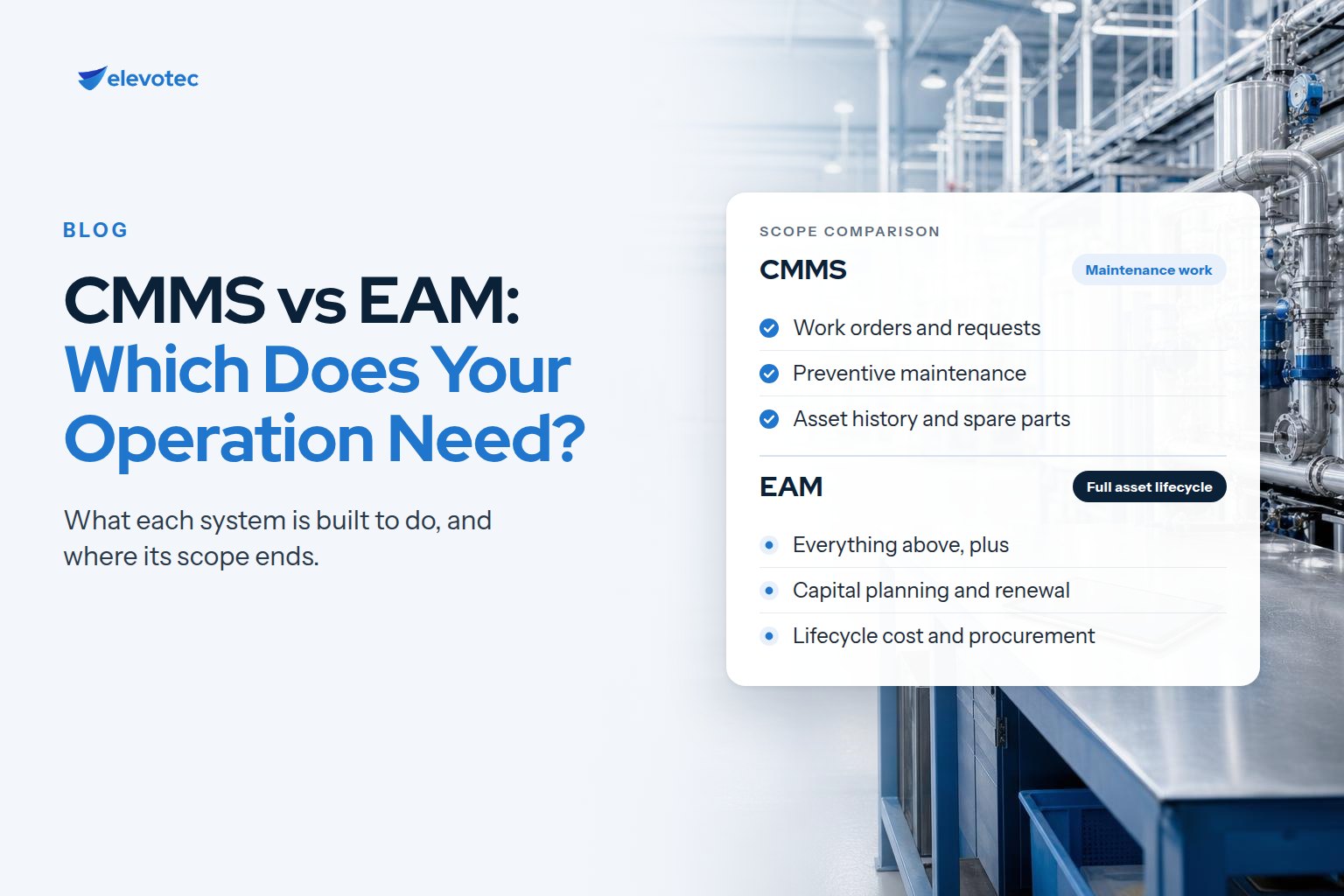
A computerized maintenance management system (CMMS) is centred on maintenance work. Its job is to make sure the right work is planned, done, recorded and learned from. A CMMS typically covers:
- Work requests and work orders, from creation to close-out
- Preventive maintenance schedules based on time, meter readings or condition
- An asset register with the maintenance history of each piece of equipment
- Spare parts and maintenance inventory
- Labour, crafts and scheduling
- Maintenance reporting and key performance indicators
The people who live in a CMMS are technicians, planners, schedulers and maintenance supervisors. The questions it answers are practical: what needs doing, who is doing it, was it done, and what did it take.
What an EAM system is built to do
Enterprise asset management (EAM) software looks at assets across their whole life: planning and acquisition, operation and maintenance, and eventually renewal or disposal. Maintenance is one important part of an EAM system, but it is not the whole of it. An EAM system usually extends into:
- Capital planning and asset renewal decisions
- Lifecycle cost tracking for each asset or asset class
- Procurement, contracts and supplier management
- Project and shutdown management
- Linear and distributed infrastructure, such as pipelines, networks and roads
- Deeper integration with finance and enterprise resource planning (ERP) systems
The users of an EAM system reach beyond the maintenance department into finance, engineering, capital planning, procurement and senior management. The questions it answers are longer-range: what do we own, what is each asset costing us over its life, and when should we repair, refurbish or replace it?
For a fuller introduction to EAM on its own terms, see what EAM software is and what it covers.
Where the two overlap
Both types of system manage work orders, preventive maintenance, an asset register and spare parts. Many CMMS products have added multi-site and enterprise features, and every serious EAM suite includes a full maintenance module. That is why a feature-by-feature checklist rarely settles the decision: both columns end up full of ticks.
The real difference is scope and depth. A CMMS is designed around the maintenance function and does that job thoroughly. An EAM system is designed around the asset as a financial and operational object, and connects maintenance to the rest of the business that funds, buys and replaces those assets.
Questions that decide which one you need
Who will use the system every day?
If the daily users are almost entirely the maintenance team, a CMMS is built for exactly that audience. If finance, engineering or capital planning need to work in the system, rather than receive a report from it, that points towards EAM.
Which decisions does it have to support?
Running the work well, day to day and week to week, is the core of a CMMS. Long-horizon decisions about renewal, capital budgets and lifecycle cost are where an EAM system earns its broader scope.
How many sites, business units and asset types are involved?
Several plants with similar equipment and a shared maintenance standard is a different problem from many business units with different asset classes, cost structures and regulators. The more varied the portfolio, the more an enterprise data model matters.
How tightly must it connect to the rest of the business?
Almost every maintenance system needs some connection to purchasing or finance. The question is how much: exchanging parts and cost data is a common integration, while running procurement, contracts and capital projects through the same system is an EAM-scale programme.
How long do your assets live, and how regulated are they?
Assets with service lives measured in decades, and regulators who expect evidence about their condition and renewal, push the decision towards lifecycle management. Shorter-lived production equipment managed mainly for uptime is the natural territory of a CMMS.
How much change can the organization absorb at once?
A wider scope means more processes to redesign, more data to prepare and more people to train. A system that is right on paper but too big to adopt is worse than a smaller one that people actually use.
Two common mistakes
The first is buying for the organization you might become in ten years. An EAM programme sized for a future structure can stall the maintenance improvements you need now. The second is the opposite: stretching a maintenance system to cover capital planning and lifecycle costing through exports and spreadsheets, until the spreadsheets become the real system again.
Whichever type you choose, the result depends less on the label than on the data you load and the processes you agree before configuration starts. Our guide to migrating maintenance data to a new CMMS covers the data side, and what drives the cost of a CMMS implementation covers scope and effort.
Choosing between specific platforms
Elevotec implements one platform of each type: eMaint X5, a CMMS, and Octave Attune EAM. If you are weighing those two, the Which solution fits? page compares them side by side. You can also see what eMaint X5 does, or read about Octave Attune EAM implementation.
If you would rather work through the decision with structured questions first, the CMMS / EAM Transformation Assessment helps clarify whether to implement, replace, optimize or modernize.